
Audit the current pixel
We check what's firing, what's missing, and where the Event Match Quality score is being lost.

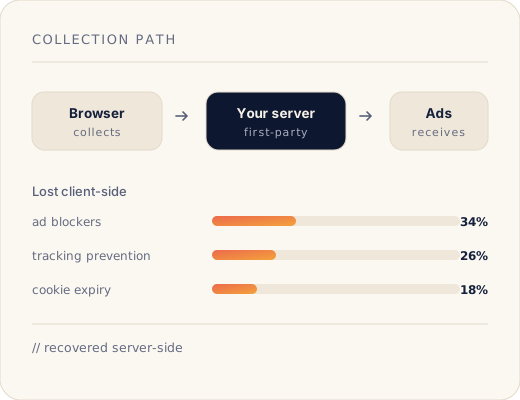
The browser pixel alone hasn't been reliable for years. We pair it with a server-side Conversions API feed so Meta still sees the sale, even when Safari and ad blockers don't let it.
The damage doesn't show up as an error message. It shows up as numbers that quietly stop making sense.
Cost per acquisition climbs when the algorithm can't tell who actually converted, so it keeps paying for guesses instead of buyers.
Delivery drifts toward whoever looks cheapest to reach, not the people who were actually going to buy.
Sales are happening on the site that Meta never sees. Reported ROAS looks worse than reality, and profitable campaigns get killed on bad information.
The Conversions API moves data collection onto your own server, so the algorithm gets pristine data instead of wasting budget on the wrong impressions.






Sending events Meta never sees from the browser, straight from your own server. The call doesn't depend on a cookie surviving Safari's Intelligent Tracking Prevention or a script slipping past an ad blocker, because it isn't a script running in the visitor's browser at all.
Deliverable: Server-side event feedPixel and CAPI reconciled against each other, so nothing counts twice. Each event carries a shared identifier both paths check before reporting, so a purchase that fires from the browser and the server still lands in Meta as exactly one conversion, not two.
Deliverable: Deduplication configuredEmail and phone attached to every event, hashed, for stronger matching. Meta never sees the raw value, only a one-way hash it can compare against its own signed-in user data — which is what actually moves Event Match Quality, not just having the fields present.
Deliverable: Pixel & CAPI auditPageView, ViewContent, AddToCart and Purchase, tied to how the funnel actually works. Each step reflects a real action a customer took on your site instead of a generic template, so the algorithm is learning from the funnel you actually run, not a guess at one.
Deliverable: Funnel steps QA'dVerified and improved, not just switched on in the interface and left alone. We check the score in Events Manager's own diagnostics right after launch, then again once traffic has had time to settle, rather than assuming a green checkmark means it worked.
Deliverable: EMQ score improvedSo EU traffic keeps reporting correctly instead of silently going dark. Consent signals flow into the same server-side pipeline as everything else, so a visitor who declines tracking is still respected, without the account losing visibility into the traffic that does consent.
Deliverable: Consent Mode verifiedWe check what's firing, what's missing, and where the Event Match Quality score is being lost.
A Conversions API integration matched to your platform, sending events your browser pixel can't.
Tested with Meta's Events Manager test tool so pixel and CAPI agree, and nothing doubles up.
What's tracked, how it's matched, and how to check it stays healthy after we're done.
Our Event Match Quality had been sitting in the "poor" band for over a year and nobody upstream ever flagged it. Within three weeks of the CAPI rebuild it was up in the high 7s, and cost per lead dropped with it.
We assumed Safari traffic just didn't convert as well and had more or less written it off as a weaker channel for us. Turned out the pixel was losing a third of those events before they ever reached Meta — the customers were there the whole time, we just couldn't see them. CAPI recovered them, the reporting stopped contradicting what our order system said, and the account finally had a real picture of iOS performance instead of a guess dressed up as a dashboard.
Our pixel and a half-finished CAPI setup from a previous agency were both firing on checkout. Every purchase was counted twice for months before anyone caught it. Deduplication alone paid for the project.
Ad blockers were quietly stripping the pixel on a big enough share of our audience that our retargeting pools had shrunk without us noticing, and we'd been blaming creative fatigue for months. Moving the call server-side stopped the block entirely, and within a couple of weeks those audiences were back to a size we could actually spend against.
We'd turned on Consent Mode ourselves and traffic from the EU basically vanished from reporting overnight. They wired it into the CAPI feed properly instead of just flipping a switch, and the modelling actually holds up now.
Our account had been stuck in the Learning Phase for months and support kept telling us to just wait it out. Once the server-side feed was sending complete data, it exited within days and CPA settled at almost half of what we'd been paying.
Enhanced conversions had been switched on for over a year with nobody ever checking whether it was actually matching. It wasn't — hashed data was missing on two of our three conversion actions. That gap alone explained most of our reporting drift.
Our retargeting audiences had been quietly shrinking for a year and marketing just assumed the category was saturated. It was the pixel under-reporting engagement the whole time, not the market.
We'd been told our tracking was "basically fine" by two previous freelancers. The actual audit turned up three conversion actions counting on "every" instead of "one," inflating volume for a year.
Usually yes, for the server-side call itself. If you're on Shopify or WooCommerce we can often use a platform integration instead, which needs no custom code.
The improvement shows within days once the server events start flowing, though the score itself is a rolling average and takes a couple of weeks to fully settle.
No. CAPI works alongside the browser pixel, not instead of it. Deduplication is what stops the two from double-counting.
Yes — that's most of the point. A server-side event doesn't depend on a browser cookie surviving, so it isn't affected by ITP or App Tracking Transparency the same way a pixel is.
Send us access and we will come back with a written audit: what is tracked, what is double-counted, what is missing, and what we would change first.
No pitch deck · No lock-in · Findings are yours either way